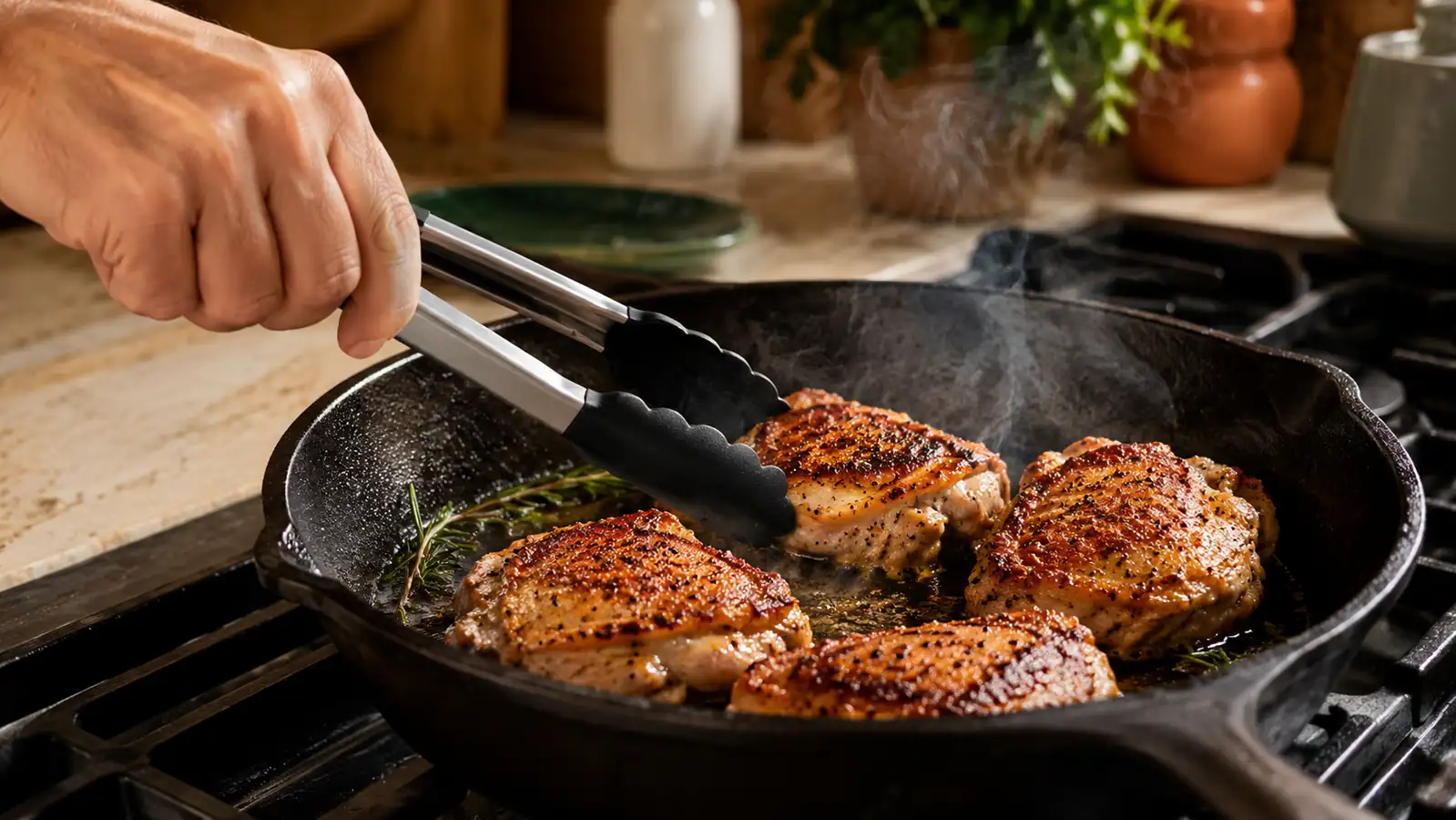
For about a year I ruined more chicken thighs than I want to admit, not because I couldn't cook them, but because I couldn't flip them. I'd get a good sear going, go in for the flip, and half the skin would stay welded to the pan while the rest came with the meat, curled and torn, looking nothing like the crispy, even crust I'd worked ten minutes to build. Same story with salmon. I'd lift a fillet and watch a third of it flake off and stick behind, leaving a ragged edge and a pan that needed to be scraped clean before the next batch.
I assumed the problem was my pan, or my oil, or that I just needed a better nonstick coating. It was actually my tongs. I was using a cheap flimsy pair with metal tips that pinched instead of scooped, and I was flipping too early, before the food had actually released from the surface on its own. Once I switched to a pair of HOTEC locking tongs with silicone tips and changed how I timed the flip, the tearing basically stopped. This is the exact five-step process I use now, whether it's chicken thighs, a steak, salmon, or a pan of vegetables.
Torn skin and shredded fish usually mean your tongs, not your pan, are the problem.
These are the HOTEC locking tongs I use for every flip below, wide silicone-tipped jaws that scoop instead of pinch, and a locking hinge so they store flat in a drawer instead of taking up a crock on the counter.
Amazon Check Today's Price on Amazon →Step 1: Pick Tongs That Scoop, and Preheat the Pan Properly
Before any of this matters, the tool itself has to be right. A lot of the tongs I see people use are either too flimsy to hold real weight, like a whole chicken thigh, or they've got hard metal or ridged tips that grip by pinching into the food rather than cradling underneath it. The HOTEC set I use has wide silicone-tipped jaws, the 12 inch pair for the stove and the 9 inch for smaller pans, and the silicone flexes just enough to wrap around the shape of the food instead of biting into it. That difference alone fixed most of my tearing problem before I changed anything else.
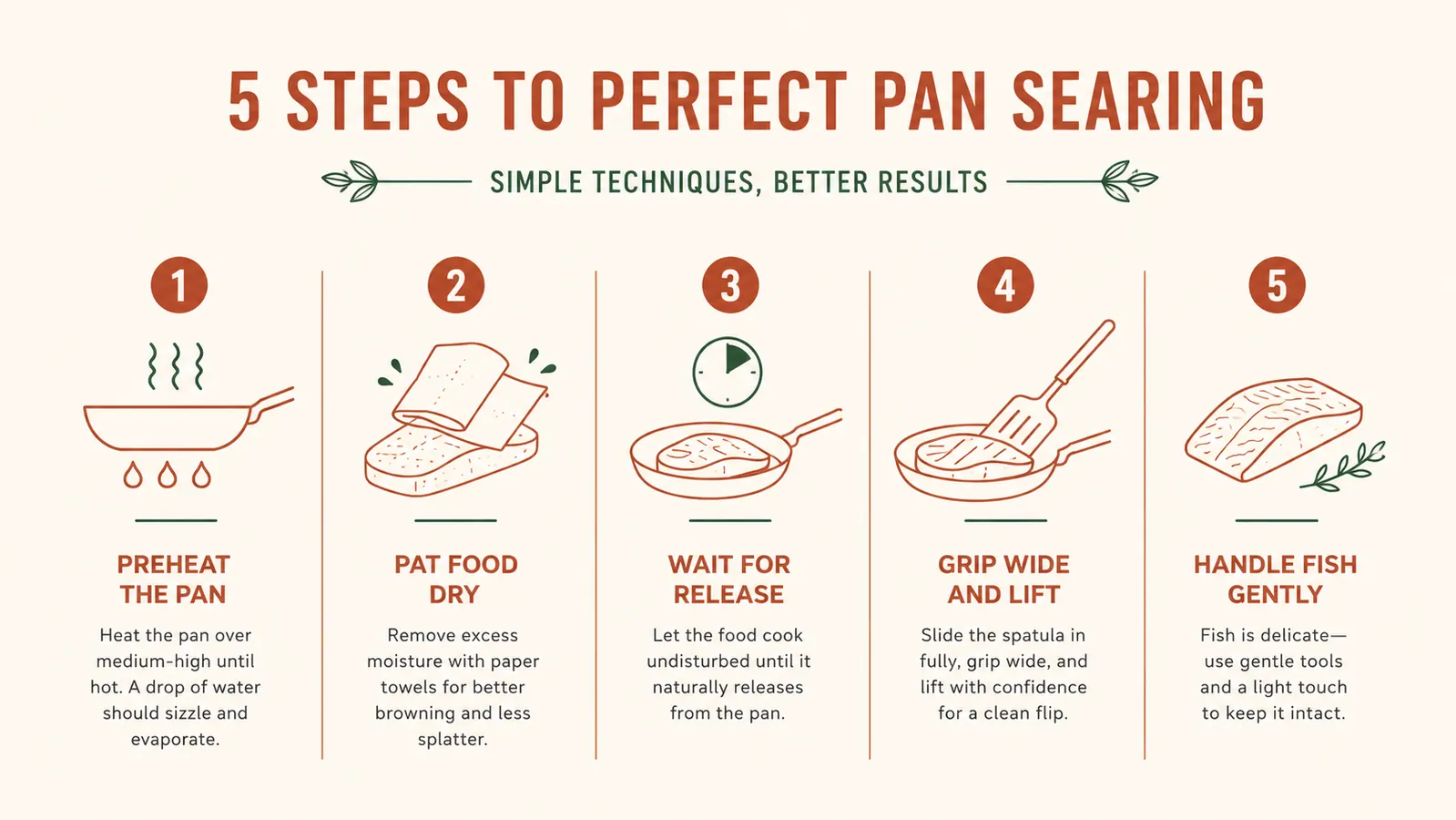
Preheating matters just as much. I let my cast iron or stainless pan sit over medium heat for a full three to four minutes before oil goes in, then let the oil shimmer for another thirty seconds before food touches the pan. A pan that's actually hot forms a crust fast, and that crust is what eventually releases cleanly. A pan that's still lukewarm when the chicken hits it never builds that crust properly, so the protein bonds directly to the metal instead of to itself, and no tongs on earth will flip that cleanly.
If I'm using nonstick instead of cast iron, I still preheat, just on medium instead of medium-high, and I still use the silicone-tipped tongs specifically because metal tips can scratch a nonstick coating over time, which only makes future sticking worse. The tool and the pan need to be working together, not against each other.
I also stopped buying tongs as an afterthought. For years I grabbed whatever cheap pair was near the register, figuring a pair of metal pinchers is a pair of metal pinchers. The HOTEC pair costs less than most of those throwaway versions, but the jaws stay aligned after two years of daily use, and the silicone tips haven't cracked or peeled, which is usually the first thing to go on a cheap pair left near a hot burner too often.
Step 2: Pat the Food Dry and Don't Crowd the Pan
Surface moisture is the single biggest reason food sticks and tears, more than the pan, more than the oil, more than the tongs. Water on the surface of chicken, fish, or vegetables has to steam off before browning can even start, and while it's steaming, the food sits there in a wet, half-cooked state that bonds to the pan surface instead of forming a crust that will release on its own.
I pat everything dry with paper towels right before it goes in the pan, chicken thighs, steak, salmon, all of it. For salmon especially I'll press a little harder along the skin side, since that's the part I'm relying on to crisp up and act as a natural release layer. It only takes ten seconds and it makes a bigger difference than almost anything else on this list.
Crowding the pan causes the same problem from a different angle. Too much food in one pan drops the surface temperature and traps steam between pieces, so nothing actually sears, it just simmers in its own moisture. I cook in batches now, usually three or four chicken thighs at a time in a 12 inch skillet instead of jamming in six, and I use the tongs to space each piece with a little breathing room between them, not touching.
The same rule applies to vegetables, even though people rarely think about it there. A pan piled high with zucchini or green beans just steams in its own liquid, and you end up with the pale, slightly slimy vegetables you get from a bad stir-fry rather than anything browned. I spread vegetables in a single layer whenever I can, even if it means doing two smaller batches instead of one crowded one, and I use the wide tongs to keep shifting them so every side gets contact with the hot pan surface instead of sitting in one spot.
Step 3: Wait for the Release, Don't Force the Flip
This is the step that actually solved my tearing problem, more than any tool change. Food that's properly seared will release from the pan on its own once the crust has fully formed. If you try to flip before that happens, you're not lifting the food, you're tearing it away from the pan, and whatever crust had started to form stays behind.
I test for release with the tips of the tongs instead of guessing on a timer. I'll slide the tongs slightly under one edge of the chicken thigh or salmon fillet and give it a gentle nudge. If it resists and feels stuck, I leave it alone for another minute and test again. If it slides freely with almost no resistance, it's ready. For a bone-in chicken thigh skin-side down, that's usually six to eight minutes over medium-high heat, not the three or four minutes I used to rush it at.
Salmon releases faster, usually four to five minutes skin-side down, and you can actually see it happening, the edges turn opaque and slightly curl up before the whole fillet lets go. Vegetables like thick-cut zucchini or bell pepper strips are the most forgiving here, since there's no delicate protein structure to tear, but even then I still test before flipping instead of just flipping on a schedule.
Steak follows the same release rule, though it's a little more forgiving than chicken skin or fish because the muscle fibers hold together better. Even so, I test a two-inch ribeye the same way, a light nudge with the tong tips at the edge, and I don't touch it again until it moves freely. Rushing a steak flip doesn't usually tear it apart the way it does salmon, but it does rip away the crust that's forming, which is the entire reason to sear a steak in the first place.
Step 4: Grip Wide and Lift, Don't Pinch and Drag
Once food has released, how you actually use the tongs matters. I open the jaws as wide as the piece of food allows and close them just enough to hold it securely, never squeezing hard. A firm pinch on a chicken thigh will push juices out and can crack a crispy skin right where the tongs grip it. The goal is enough pressure to lift and control the food, not enough to compress it.
I lift straight up and slightly toward myself before rotating, rather than dragging the food sideways across the pan first. Dragging is what catches any part of the crust that hasn't fully released yet and tears it, even if 90 percent of the piece let go cleanly. A clean lift, then a flip in the air over the pan, then set it back down, keeps everything intact.
The locking hinge on the HOTEC tongs also changes how I hold them day to day. Because they lock closed flat, I keep them right in the utensil crock next to the stove instead of buried in a drawer, which means I actually reach for them instead of grabbing a fork to stab at whatever's in the pan. A fork punctures meat and lets juices run out, which is its own way of drying out a piece of chicken before it even hits the plate.
For a thick steak or a bigger cut like pork chops, I grip closer to the middle of the piece rather than at one edge, so the weight is balanced across the jaws instead of tipping down on one side. An unbalanced grip is how a heavy piece of meat slips loose mid-flip and lands half in, half out of the pan, which is its own kind of mess and usually costs you the crust you just spent ten minutes building.
Step 5: Handle Delicate Fish and Vegetables With a Lighter Touch
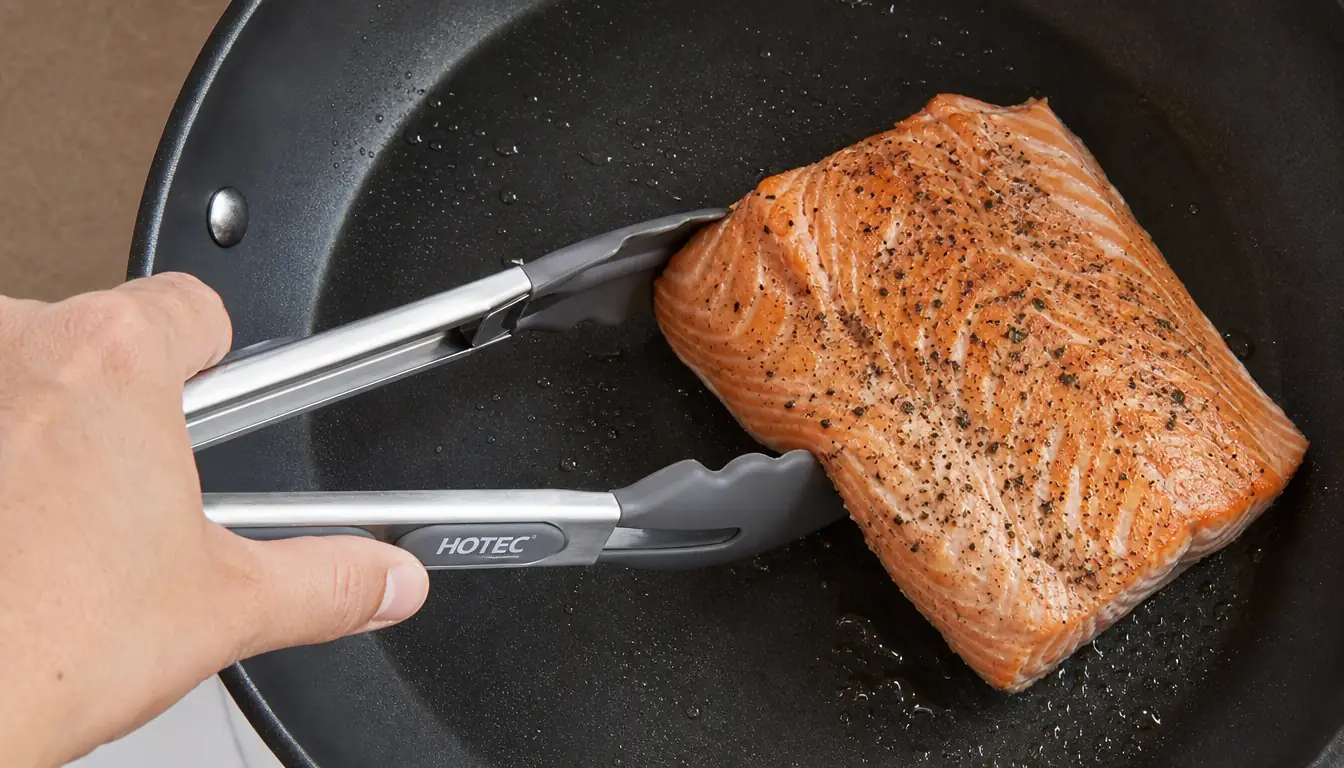
Salmon and other flaky fish need a slightly different approach than chicken or steak. Instead of gripping from the top down, I slide the tongs in from the side, low and flat against the pan, so the wide part of the jaw supports the underside of the fillet like a small spatula rather than clamping down from above. The silicone tips flex to match the curve of the fish instead of digging in at one point.
I also flip fish only once if I can help it. Every extra flip is another chance for the flesh to break along a natural seam, so once the skin side is properly crisped and released, I flip it, give the flesh side just two or three minutes since it cooks faster than the skin side did, and pull it off the heat. For a fillet with the skin still on, I always start skin-side down, since the skin acts like natural armor and gives the tongs a sturdier surface to grip during that one flip.
Vegetables get the most casual handling of the bunch. For a pan of asparagus or green beans, I'm not flipping individually, I'm using the tongs almost like a small rake, tossing and turning the whole batch every couple minutes so everything gets even color without babying each piece. The wide silicone tips are gentle enough that I don't bruise or snap tender spears the way a metal spatula edge sometimes will.
What Else Helps
A few small habits make this whole process even more reliable. I keep my tongs within reach of the stove at all times, not in a drawer across the kitchen, because the version of good technique that actually works is the one you don't have to think about or go searching for mid-sear. I also wipe the pan clean with a paper towel between batches if I'm cooking in multiple rounds, since leftover bits from the first batch can burn and stick to the next round of food. And I've learned to trust the release test over the clock every time. My stove runs a little hotter than my old one did, so a recipe's stated flip time is a rough guide at best, the tongs test is what actually tells me the food is ready.
Oil choice matters more than people expect too. A neutral oil with a higher smoke point, avocado or refined vegetable oil rather than extra virgin olive oil, holds up better at the medium-high heat you need for a real sear, and it won't start smoking and turning bitter before the crust has fully formed. I keep a bottle of avocado oil next to the stove specifically for searing and save the good olive oil for finishing or lower-heat cooking.
Cleaning the tongs properly extends how long the silicone tips stay flexible, which keeps them gripping food gently instead of getting stiff over time. Mine go straight into the dishwasher after most meals, but for stubborn grease along the hinge I'll hand wash with warm soapy water and dry them fully before locking them closed, since trapping moisture in a closed hinge invites rust on the stainless steel.
Torn skin and shredded fish were never a pan problem for me. They were a timing problem and a tool problem, and fixing both took less effort than I expected.
Wide silicone jaws, a real lock, and no more torn skin at the flip.
This is the same HOTEC locking tongs set I use for every step above, 9 inch and 12 inch, dishwasher safe, and it locks flat so it actually stays within reach by the stove.
Amazon Check Today's Price on Amazon →